Many people are searching for the term “Karoline Leavitt lawsuit” because her name has appeared in news reports, court filings, social media posts, and viral claims about media disputes. The phrase can be confusing because not every story connected to her is actually a personal lawsuit against her. Some online posts mix real legal cases with rumors, political arguments, and exaggerated headlines.
The main real lawsuit connected to Karoline Leavitt is the Associated Press case over White House press access. In that case, the AP sued several White House officials, including Leavitt in her official role as White House press secretary. The lawsuit focuses on whether the administration restricted AP journalists from certain press events because the news organization refused to follow the administration’s preferred wording for the Gulf of Mexico.
This article explains the Karoline Leavitt lawsuit in simple terms. It covers the real AP case, why the dispute started, what the First Amendment claim means, how the administration defended its actions, and what the latest status appears to be. It also separates the confirmed lawsuit from online confusion involving The View, BBC, CBS, and other media-related controversies.
Quick Guide Table
| Topic | Simple Explanation |
| Main lawsuit | The real case is connected to Associated Press v. Budowich et al. |
| Why Karoline Leavitt is involved | She is named because of her official role as White House press secretary. |
| Core issue | AP says its access was restricted because of its editorial wording. |
| Legal focus | The case centers on First Amendment rights and press access. |
| Common confusion | Online claims mix the AP case with rumors about The View, BBC, and CBS. |
| Reader takeaway | This is mainly an official-capacity media access lawsuit, not a personal lawsuit about Leavitt’s private life. |
Helpful Bullet Points for Readers
- The Karoline Leavitt lawsuit is mostly about the AP press access dispute.
- The case is linked to the “Gulf of Mexico” vs. “Gulf of America” wording issue.
- Karoline Leavitt is involved through her White House press secretary role.
- The AP argues the restrictions were based on editorial viewpoint.
- Some viral claims about other lawsuits are not the same as the real AP case.
- Readers should separate verified court cases from social media rumors.
Karoline Leavitt Lawsuit: What the Case Is Really About
The Karoline Leavitt lawsuit is not mainly about her personal life, private conduct, or a business dispute. It is about her official position in the White House and the administration’s treatment of the Associated Press.
The core issue is press access. The Associated Press argued that its reporters were blocked from certain White House press pool events because of the AP’s editorial decision to keep using the name “Gulf of Mexico” while also acknowledging the administration’s preferred name, “Gulf of America.” The AP said this kind of restriction punished a news organization for its wording and viewpoint.
Karoline Leavitt is connected to the case because she served as White House press secretary and was one of the officials named in the lawsuit in an official capacity. That means the case is not framed as a personal lawsuit about her private actions. It is about whether government officials can restrict a media outlet’s access based on editorial choices.
For general readers, the simplest way to understand the case is this: the AP says the White House punished it for its reporting language, while the administration says limited press access is a privilege that officials can manage.
Associated Press v. Budowich et al.: The Main Lawsuit Explained
The main case connected to this topic is Associated Press v. Budowich et al. The lawsuit was filed by the Associated Press in federal court in Washington, D.C. The named officials included Taylor Budowich, Karoline Leavitt, and Susie Wiles, all in their official White House roles.
The AP claimed that the White House’s decision to limit its access violated constitutional protections, especially the First Amendment. The First Amendment protects free speech and freedom of the press. In this case, the AP argued that the government was retaliating against it because of an editorial choice.
The case became important because it raised a broader question: when the White House opens certain events to selected journalists, can it exclude one news organization because it dislikes the words that organization uses? That question is why the lawsuit received attention from press freedom groups, legal commentators, and political reporters.
It is also why the keyword “Karoline Leavitt lawsuit” has become popular. Her name appears in the case because she was press secretary during the access dispute, not because the lawsuit is centered on a private claim against her.
Why the AP Was Restricted From White House Press Access
The AP access dispute started with a naming disagreement. The Trump administration used the term “Gulf of America,” while the Associated Press continued to use “Gulf of Mexico” in its reporting style. The AP’s position was that the Gulf of Mexico is the long-standing name used internationally, while also noting the administration’s chosen terminology.
After that, AP journalists were restricted from some limited-access White House events. These included events in places such as the Oval Office, Air Force One, and other settings where only a small number of journalists can attend. These spaces are often covered by the White House press pool, which allows a small group of reporters, photographers, and broadcasters to gather news on behalf of the larger press corps.
The dispute was not about whether every journalist has an automatic right to enter the Oval Office or travel on Air Force One. Even the AP’s argument did not depend on that broad idea. Instead, the AP argued that if the White House gives access to some journalists, it cannot deny access to one outlet because officials dislike that outlet’s editorial viewpoint.
This distinction is important. The case is not simply about special access. It is about whether the government can use access as a reward or punishment for media language.
Karoline Leavitt’s Role as White House Press Secretary
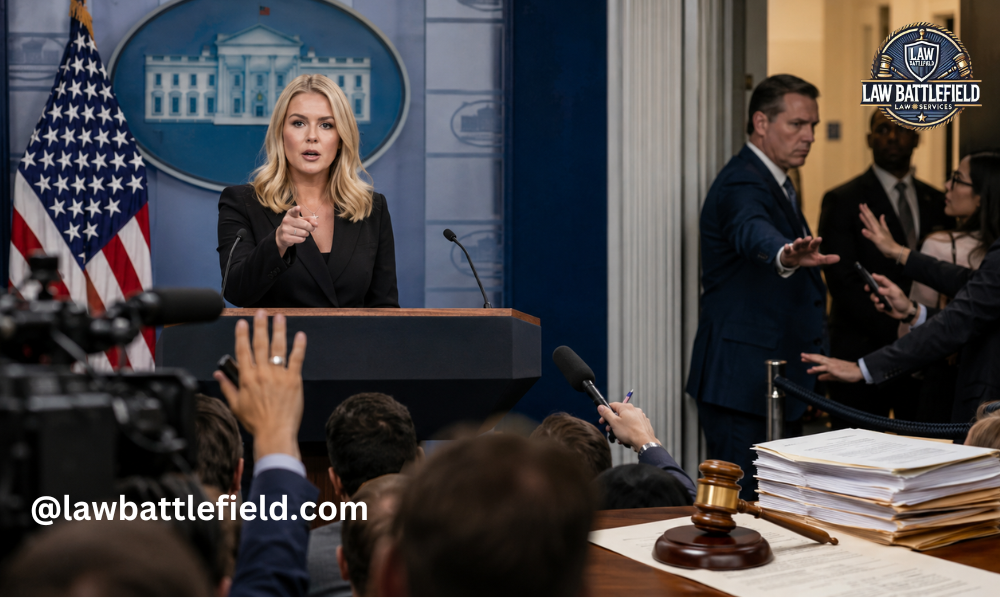
Karoline Leavitt press secretary searches increased because her role places her at the center of White House-media communication. The White House press secretary speaks for the administration, handles briefings, answers reporters’ questions, and often explains or defends the administration’s media policies.
In the AP lawsuit, Leavitt is named because of that official role. Readers should understand that this does not mean she is being sued over a private personal matter. It means the AP challenged actions connected to the White House communications operation.
Many people also search “is Karoline Leavitt still press secretary.” Based on recent official White House video pages and current media reports, Leavitt has continued to be identified as White House press secretary in 2026. She also returned to public duties after maternity leave, according to recent coverage.
Her position matters because the press secretary’s office is often where media access rules, briefing procedures, and official statements become visible to the public. That is why her name appears in both serious legal reporting and social media discussions about the case.
The First Amendment Claim Behind the Lawsuit
The First Amendment claim is the heart of the Associated Press lawsuit. In plain English, the AP says the government cannot punish a news organization for choosing its own words.
The AP’s argument is based on the idea of viewpoint discrimination. Viewpoint discrimination means treating someone differently because of the opinion, wording, or perspective they express. In this case, the AP says it was denied access because it would not fully adopt the administration’s preferred name for a geographic location.
The issue matters because journalists make editorial decisions every day. They decide which words to use, which facts to emphasize, and how to describe government actions. If government officials can punish a news outlet for using language they dislike, press freedom groups argue that other journalists may feel pressure to change their reporting to avoid losing access.
This does not mean the press has unlimited access to every government space. Courts have often recognized that some places are controlled and restricted. But the AP’s position is that once the government opens access to selected journalists, it must make those decisions in a viewpoint-neutral way.
The Administration’s Defense in the Case
The administration’s defense has focused on discretion and control over limited spaces. The White House has argued that access to areas like the Oval Office, Air Force One, and small presidential events is not the same as general access to public information. These are limited spaces where officials decide which journalists can attend.
From the administration’s point of view, press pool access is not an absolute constitutional right. Officials have argued that the president and White House staff must be able to manage access for practical, security, and logistical reasons.
This defense is different from saying reporters cannot criticize the government. The administration’s argument is more about control over access to special settings. In simple terms, the White House position is that not every journalist is entitled to every seat, every trip, or every limited event.
The legal debate is about where discretion ends and unconstitutional punishment begins. The AP says the restriction was based on viewpoint. The administration says the White House has broad authority over limited presidential access. That is the central conflict the courts have been asked to address.
Current Status of the Karoline Leavitt Lawsuit
Last updated: June 29, 2026.
The case has gone through several important stages. Early in the litigation, the district judge denied the AP’s request for an immediate emergency order. Later, the same court granted a preliminary injunction in favor of the AP, saying the government could not exclude journalists from opened press events because of their viewpoint.
The administration appealed. The D.C. Circuit then allowed some of the White House restrictions to remain in place while the appeal continued, especially for highly restricted presidential spaces such as the Oval Office and Air Force One. However, the appeals court treated some other spaces, such as the East Room, differently.
The latest reliable status is that the appeal remained significant after oral argument at the D.C. Circuit. Searches and docket summaries show that oral argument took place in November 2025, and the case continued to be tracked in 2026. Readers should avoid relying only on old headlines because earlier reports may mention only the emergency denial or only the district court injunction without explaining the later appeal.
In short, the Karoline Leavitt lawsuit is best understood as an ongoing or developing First Amendment press-access dispute unless a newer final ruling is confirmed.
The View Lawsuit Update and Karoline Leavitt Mentions
Searches for “the view lawsuit update” and “what did The View say about Karoline Leavitt” often appear beside searches for the AP lawsuit. This creates confusion because viral posts have claimed that Leavitt sued The View for hundreds of millions of dollars.
The confirmed picture is different. Fact-checking has found no verified evidence that Karoline Leavitt successfully sued The View for $800 million. Many of those claims appear to come from viral videos, social media posts, or clickbait-style headlines rather than real court filings.
There was public commentary involving The View and Leavitt. For example, comments about her qualifications and appearance drew criticism online. But a controversial comment on a talk show is not automatically a lawsuit. A real lawsuit normally requires a court filing, named parties, claims, and a docket that can be checked.
For readers, the key point is simple: The View-related claims should not be treated as the main Karoline Leavitt lawsuit. The real legal case most clearly connected to her name is the Associated Press press-access case.
BBC and CBS Media Disputes Linked to Karoline Leavitt
Karoline Leavitt’s name has also appeared in stories involving BBC and CBS, but these should be separated from the AP lawsuit.
The BBC matter involved President Trump’s dispute with the British broadcaster over edited footage from a documentary connected to January 6. Reports described a major legal threat and later litigation involving Trump and the BBC. Leavitt was connected to the public messaging around the dispute, but it is not the same as the AP case and should not be described as a personal Karoline Leavitt lawsuit.
The CBS controversy involved a tense exchange over whether a Trump interview would air in full. Reports said Leavitt warned CBS about legal action if the interview was edited. CBS later aired the interview in full. Again, this was a media confrontation and legal threat, not the same as the AP lawsuit.
These examples matter because they show how easily headlines can blur different events together. A lawsuit, a legal threat, a public insult, and a media dispute are not the same thing. When writing or reading about the Karoline Leavitt lawsuit, it is important to identify which event is actually being discussed.
False Rumors and Misleading Claims About Karoline Leavitt Lawsuits
False or exaggerated claims often spread quickly when a public figure is involved in political controversy. Karoline Leavitt is a high-profile White House official, so her name attracts both legitimate news coverage and misleading viral content.
Not every headline that uses the word “lawsuit” is reliable. Some posts claim major court victories without naming a court. Others mention huge dollar amounts but provide no docket, complaint, judge, or legal source. These are warning signs.
A simple checklist can help readers separate fact from rumor:
- Is there a real court filing?
- Are the parties clearly named?
- Is Karoline Leavitt sued personally or in her official capacity?
- Is the story about a lawsuit, a legal threat, or only a public comment?
- Does the claim come from a reliable news outlet, court record, or fact-checking source?
Using this checklist helps readers avoid confusing the real AP case with viral claims about The View, CBS, BBC, or other media stories.
Karoline Leavitt Background: Age, Husband, Parents, and Public Profile
Many readers who search for the Karoline Leavitt lawsuit also search for background details such as Karoline Leavitt age, Karoline Leavitt husband, Karoline Leavitt parents nationality, and Karoline Leavitt net worth. These searches are common because people often want to understand who a public official is after seeing their name in legal or political news.
Karoline Leavitt was born in 1997, which makes her 28 years old as of June 2026. She is known as one of the youngest people to serve as White House press secretary. She is married to Nicholas Riccio, a real estate developer, and public reports have discussed their family life and children.
Details about her parents and family background should be handled carefully. Public interest does not mean every private detail is necessary or fully verified. If an article mentions Karoline Leavitt parents nationality, it should rely only on confirmed public information and avoid speculation.
The same caution applies to Karoline Leavitt net worth. Many websites publish estimated net worth figures, but those numbers are often not based on verified financial disclosures. A careful article should say that exact net worth claims are uncertain unless backed by reliable records.
Karoline Leavitt Wikipedia Searches and Why Readers Look Her Up
The related keyword “Karoline Leavitt – Wikipedia” shows that many readers are looking for a quick background summary. Wikipedia-style searches usually happen when a person becomes part of a major news story and readers want basic facts: age, job, political background, education, family status, and current role.
For this topic, background information should support the main story rather than distract from it. The article should focus on her role as White House press secretary and why that role connects her to the AP lawsuit. Long personal details, gossip, or unverified claims would weaken the article and make it less helpful.
A reader searching this topic likely wants clarity. They want to know whether there is a real lawsuit, what it is about, whether Leavitt is personally accused of something, and what the latest update is. A useful article should answer those questions before moving into short background context.
That approach also makes the content safer for search engines because it avoids thin celebrity-style writing and focuses on verified public-interest information.
Why This Lawsuit Matters for Press Freedom and White House Coverage
The Karoline Leavitt lawsuit matters beyond one press secretary or one news organization. It raises a larger question about how much power the government has to control media access based on how journalists report the news.
White House press access is important because many presidential events are small, controlled, and not open to the full press corps. When only a few journalists are allowed inside, their reports, photos, and videos often help inform the wider public. If access decisions are made because of viewpoint, critics argue that it could pressure news organizations to soften or change their coverage.
At the same time, the White House does have real practical concerns. Space is limited. Security is strict. Not every journalist can attend every event. That is why the case is not as simple as saying the press must always get full access.
The important legal question is whether the government can use that limited access to punish editorial independence. The answer may shape future conflicts between presidents and the press, especially when administrations disagree strongly with how news organizations describe official policy.
Conclusion: Understanding the Karoline Leavitt Lawsuit Clearly
The Karoline Leavitt lawsuit is best understood as a press freedom and media access case, not a personal lawsuit about her private life. The main real case is Associated Press v. Budowich et al., where the AP challenged White House restrictions connected to the “Gulf of Mexico” and “Gulf of America” naming dispute.
Karoline Leavitt is involved because she served as White House press secretary and was named in her official capacity. The legal issue centers on whether the administration restricted AP access because of the outlet’s editorial viewpoint.
Readers should also be careful with viral claims. Stories about The View, BBC, and CBS may involve criticism, legal threats, or media controversy, but they are not all the same as the AP lawsuit. The most reliable way to understand the topic is to separate confirmed court cases from online rumors.
In the end, the Karoline Leavitt lawsuit matters because it touches on a basic democratic issue: how the government deals with journalists who do not use the language or framing officials prefer. Whether readers agree with the AP, the administration, or neither side, the case is an important example of the continuing tension between political power, press access, and editorial independence.
FAQs
What is the Karoline Leavitt lawsuit about?
The Karoline Leavitt lawsuit mainly refers to the Associated Press case over White House press access and whether AP journalists were restricted because of the outlet’s editorial wording.
Is Karoline Leavitt Personally Being Sued?
Karoline Leavitt is connected to the lawsuit through her official role as White House press secretary. The case is about White House media access, not her private personal life.
Why Did The Associated Press Sue?
The Associated Press sued after its journalists were restricted from some White House press events. AP claims the restriction was tied to its decision not to fully use the administration’s preferred wording.
Is The View Lawsuit Connected To Karoline Leavitt?
The View-related claims are often part of online confusion. The main verified Karoline Leavitt lawsuit topic is the AP press access case, not viral claims about The View.
Why Does This Lawsuit Matter?
The lawsuit matters because it raises questions about press freedom, government access rules, and whether officials can limit media access based on a news outlet’s editorial choices.
Was this article helpful? Check out more on Lawbattlefield.com
Disclaimer: This article is for general informational purposes only. It is not legal advice and should not be treated as an official court record. Readers should check verified court documents, trusted news sources, or legal professionals for the most current information.
Aung Kyaw Zaw MD Lawsuit Explained: Allegations And Legal Action