Ask any experienced California trial lawyer what a commercial truck case really turns on, and the answer is almost never the crash itself. It turns on the evidence gathered in the days that follow, most of it electronic, most of it under the carrier’s control, and much of it on a countdown clock.
This article looks at how a serious California trucking accident case actually gets built, working backward from the courtroom to the crash scene.
Building the Case Backward From What Wins in Court
At trial, a plaintiff in a trucking case needs to prove three things: what the driver was doing at the moment of impact, whether the carrier’s conduct fell below the standards imposed by federal regulation, and how the resulting injury translates into economic and non-economic loss. Each of those three pillars pulls on a different body of evidence.
Pillar One: What Actually Happened in the Seconds Before Impact
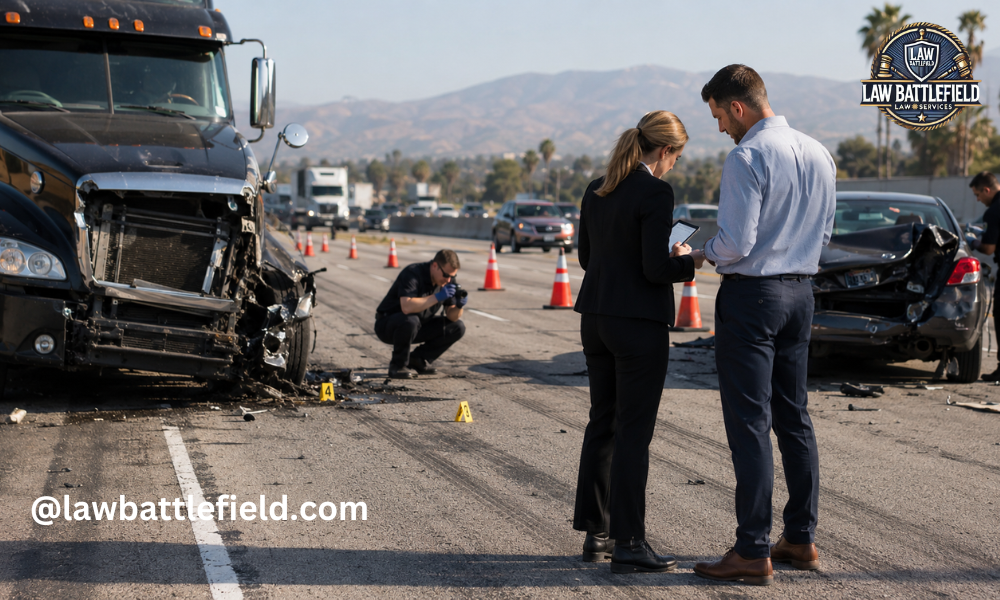
The Engine Control Module (ECM) and Event Data Recorder (EDR) built into most commercial trucks record speed, braking, throttle position, steering inputs, and cruise-control status in the seconds before a crash. This data can settle the “he said, she said” question of what the driver was doing before impact.
The problem is timing. ECM data can be overwritten in subsequent ignition cycles. If the truck is driven away from the scene, put back into service, or sent to a repair yard, the crash-window data can be gone within days. A properly drafted preservation letter, sent to the carrier and its insurer immediately, is what keeps this evidence intact.
Pillar Two: The Carrier’s Regulatory Record
Commercial carriers operate under the Federal Motor Carrier Safety Regulations at 49 CFR Parts 350 through 399. Violations of these regulations are powerful evidence of negligence, sometimes rising to negligence per se.
Categories of evidence that matter:
- Electronic Logging Device (ELD) records, which track hours of service and are required to be retained by the carrier for six months.
- Driver Qualification Files, retained for the driver’s employment plus three years, containing the CDL history, medical certification, prior-employment verification, and driving-history record.
- Vehicle Inspection Reports, retained three months (DVIRs) or 14 months (annual inspections).
- Maintenance records, retained one year while under the carrier’s control plus six months.
- Post-accident drug and alcohol testing records under federal regulation, required when the crash involved a fatality, or when the driver received a citation combined with medical treatment away from the scene or a vehicle towed.
- Internal communications between the driver, dispatcher, and safety personnel.
Each of these has its own retention window and its own procedure for preservation. A generic “please save everything” letter does not do the job.
Pillar Three: The Human Cost
Serious trucking injuries carry long tails. Traumatic brain injury, spinal cord injury, crush injuries, and amputations require lifetime medical care, home modifications, adaptive equipment, and ongoing therapy. The economic damages case is built from expert life-care planners, vocational economists, and treating physicians projecting decades of future need.
Non-economic damages, pain, suffering, loss of enjoyment of life, disfigurement, are separately compensable under California Civil Jury Instruction CACI 3905A, which tells the jury explicitly that “no fixed standard exists” for calculating these categories. The jury uses judgment based on the evidence, which means the record has to make the human cost real: witnesses, before-and-after documentation, symptom logs kept honestly and consistently.
Multi-Defendant Structure
Trucking cases rarely come down to one defendant. Typical liable parties in a California commercial truck case:
- The driver.
- The motor carrier, under respondeat superior and for direct negligence in hiring, training, supervision, or scheduling.
- The cargo loader or shipper, if unsecured or improperly loaded cargo contributed.
- The tractor or trailer owner or lessor, if separate from the operator.
- The maintenance contractor.
- The truck or component manufacturer, in strict products liability.
- A public entity, if a dangerous condition of public property contributed.
Under Proposition 51 (California Civil Code §1431.2), non-economic damages are allocated to each defendant in proportion to fault. Economic damages remain joint and several. This means that identifying every liable party early keeps the recovery pool from shrinking, especially on the non-economic side.
The Government Claims Wedge
If a public entity may share fault, a Caltrans-controlled corridor of the 405, 710, 5, 101, or PCH; a city-owned or county-owned vehicle; a dangerous condition of public property under Government Code §835, a completely separate procedure applies. Under Government Code §911.2, a formal written claim must be filed with the public entity within six months. Miss it, and the public-entity part of the case is generally barred, regardless of the two-year ordinary statute under Code of Civil Procedure §335.1.
Damages Available
California allows compensatory damages in two categories, plus punitive damages in narrow cases.
Economic damages cover documentable losses: medical care past and future, rehabilitation, long-term care, lost wages, lost earning capacity, property damage.
Non-economic damages cover the human cost: pain and suffering, emotional distress, PTSD, loss of enjoyment of life, permanent disability, disfigurement, loss of consortium.
Punitive damages under California Civil Code §3294 are separate and require clear and convincing evidence of malice, oppression, or fraud. Documented hours-of-service violations the carrier knew about, ignored maintenance defects, and hiring drivers with known dangerous histories are the common triggers.
Bottom Line: The Case Is Built in the First 72 Hours or It Is Not Built at All
A California trucking accident case is not decided at trial. It is decided in the first days after the crash, when the ECM data can still be pulled, the ELD records still exist, and the preservation letters still land in time.
The California injury victims who recover the most in these cases are not the ones with the worst injuries. They are the ones whose attorneys moved fastest to lock down evidence the carrier controls, run the multi-defendant analysis, and file the six-month Government Claims Act notice if a public agency may share fault.
At Ravan Law, attorney Ted H. Ravan handles every truck accident case personally, and the first case review is free. You pay nothing unless we recover compensation for you. If you or a family member was hit by a commercial truck in California, request a free case review with experienced truck accident attorneys in Los Angeles today, because the evidence you need may be gone by next week.
Attorney Advertising. Ted Ravan, Ravan Law, Los Angeles, CA. This content is general information, not legal advice and does not create an attorney-client relationship. Every case depends on its specific facts.