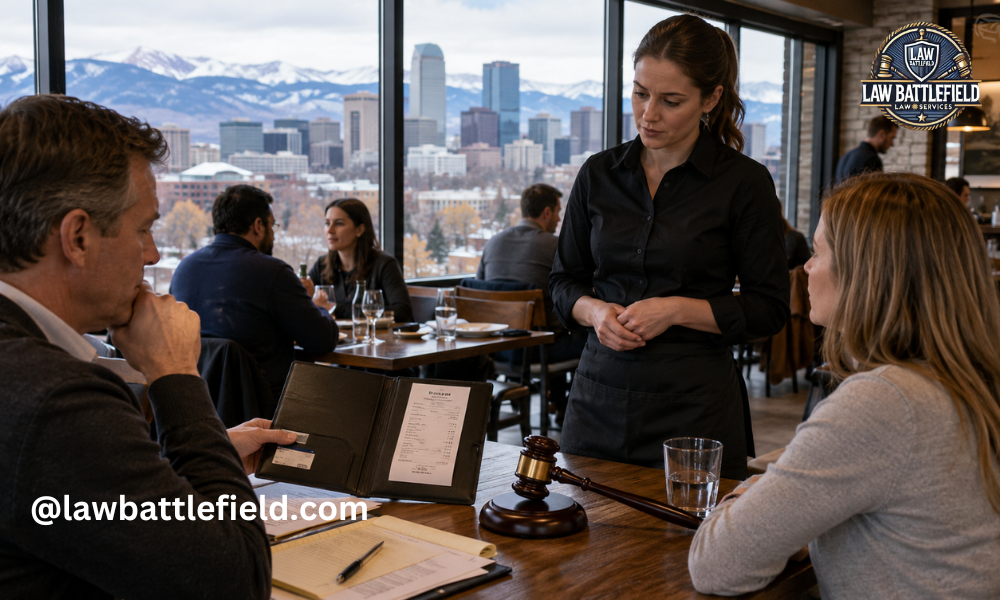
The Denver restaurant service charge lawsuit began as a dispute over how a mandatory 20% fee was described, collected, and used at restaurants operated by Culinary Creative Group, commonly called CCG. Former Kumoya server Marianna White argued that customers could reasonably believe the charge mainly supported the employees serving them, while part of the money was allegedly used to compensate managers. She also raised claims involving lower cash wages and missed paid rest breaks.
White filed the case in Denver County District Court in February 2025. In March 2026, lawyers for both sides jointly asked for the court case to be dismissed without prejudice so the remaining dispute could move into binding arbitration. That wording matters. A dismissal without prejudice did not amount to a court finding that CCG broke the law, and it did not prove that the employees’ allegations were false. It simply removed the case from the court docket without a final ruling on the central legal questions.
As of July 20, 2026, the latest credible public update located for this article is the March 25 report confirming the move to arbitration. No public arbitration award or confirmed financial settlement has been announced in that reporting.
Quick Guide Table
| Topic | What It Means |
| Lawsuit filed | Former Kumoya server Marianna White filed claims against Culinary Creative Group in February 2025. |
| Main dispute | Employees questioned how the mandatory 20% service charge was described, distributed, and used. |
| CCG’s position | CCG denied wrongdoing and argued that mandatory service charges are different from voluntary customer tips. |
| Court dismissal | The case was dismissed without prejudice, meaning the court did not make a final ruling on the allegations. |
| Binding arbitration | The dispute moved to a private process where an arbitrator may review evidence and make a binding decision. |
| Public settlement | No confirmed public financial settlement or payout has been announced. |
| Legal precedent | The dismissal did not create a binding service-charge rule for other Colorado restaurants. |
Culinary Creative Group and the Restaurants[object Object],[object Object],[object Object],[object Object] Connected to the Case
Culinary Creative Group is a well-known Denver hospitality company with a large portfolio of restaurants, bars, and related concepts. Restaurants connected to the group have included Kumoya, Tap & Burger, Señor Bear, Mister Oso, Fox & The Hen, and Bar Dough, along with other prominent Denver-area venues. CCG’s own website currently describes 2 distinct concepts.
The size and visibility of the group helped the case attract attention beyond one restaurant. Diners across Denver had encountered service charges at several popular venues, while restaurant workers and owners were already debating whether automatic fees were clearer or fairer than traditional tipping. Because CCG operates recognizable concepts and has received major local and national attention, the lawsuit became part of a wider discussion about restaurant pay systems.
The dispute was therefore not only about one server’s paycheck. It raised broader questions about what customers think they are paying, what employees are promised, and how restaurants should explain fees that appear automatically on a bill.
How the Culinary Creative Group Lawsuit Began
Marianna White worked as a server for CCG from September 2023 to January 2024, according to the original complaint. She filed her lawsuit on February 19, 2025, naming Culinary Creative Group as the defendant. The complaint alleged violations of Colorado wage-and-hour rules, including claims related to tips, service-charge money, hourly pay, tip credits, and rest periods. Tho by the plaintiff, not court findings.
Local reporting brought wider attention to the case in March and April 2025. Former workers described concerns about how the service charge affected their earnings, while CCG denied wrongdoing and defended its compensation model. Later proceedings focused heavily on the legal difference between a mandatory service charge and a voluntary tip.
By March 2026, the parties had jointly moved to dismiss the court action. White’s attorney said the matter would continue in binding arbitration, while CCG’s new chief executive described the company as finishing the remaining issues through that process. Because arbitration is handled outside a normal public trial, the fulners or other workers.
The Mandatory 20% Service Charge at the Center of the Dispute
At the restaurants involved, a 20% service charge was automatically added to customer bills. Unlike a normal tip, which a guest chooses and can change, the service charge was a required part of the amount due. Earlier menu language reportedly stated thributed to staff in an equitable manner.
That wording became central to the disagreement. Many diners are used to leaving about 20% as a tip for servers and bartenders. When a restaurant automatically adds a charge of the same size, some customers may treat it as a replacement for a traditional gratuity, even when a separate tip line remains on the receipt. A guest may therefore decide not to leave anything extra.
For workers who previously depended on tips, customer understanding can directly affect income. If diners believe the fee goes mainly to the front-of-house team, but the restaurant uses it across a wider group of employees, both sides may be following different assumptions. This gap between the restaurant’s intended meaning and the customer’s likely interpretation was one of the most important issues in the Denver restaurant service charge lawsuit.
Main Allegations About Service-Charge Distribution
White and other former employees alleged that a meaningful share of the service-charge pool was used to pay managers. Early reporting said the lawsuit claimed roughly 30% went to management. CCG acknowledged that managers received some service-chan but said the figure was closer to 10%.
The disagreement was not only about the percentage. It was also about the word “staff.” White’s side argued that customers reading a promise of equitable distribution among staff could understand it to mean the workers directly serving or preparing their meal, rather than salaried managers. CCG’s position was that managers are also members of staff and contribute to the guest experience.
This distinction is important because a service charge can be legally different from a tip while still creating a question about communication. Even when an employer has control over a mandatory fee, the exact wording used on menus, receipts, and employee documents may affect whether customers and workers were given a clear picture of the compensation system.
Wage Reductions and Rest-Break Claims
The original complaint also alleged that CCG reduced the agreed hourly rates of White and other servers and paid tipped minimum wage for some hours. Former workers separately told local media that front-of-house cash wages fell by about $3 per hour in January 2024. They argued that the reduction was especially harmful because customers often did ne automatic 20% fee.
CCG disputed the suggestion that its system unlawfully deprived employees of money. The company described the service-charge model as a way to support more balanced compensation across front-of-house, back-of-house, and management roles.
White’s complaint also included a separate allegation that employees did not receive required paid, duty-free rest periods. That issue should not be confused with the debate over service-charge distribution. It was an additional wage-and-hour claim based on working conditions. Colorado’s labor guidance separately addresses meal and rest-period rights, and the state’s official guidance page lid information for workers and employers.
Culinary Creative Group’s Response to the Allegations
Culinary Creative Group strongly denied that it stole tips or violated Colorado wage law. The company argued that the automatic fee was clearly identified as a service charge and that customers still had a separate option to leave a voluntary tip. CCG’s position was that a mandatory charge belongs to the business and may be useds, including managers.
The group also said its compensation model was designed to reduce the traditional earnings gap between servers and back-of-house employees such as cooks and dishwashers. On its current hospitality page, CCG says 100% of the service charge is distributed among employees who contribute to the dining experience, including front-of-house, back-of-house, and management team members, and that the company keeps none of it. It also states that any ly to the front-of-house service team.
Those statements explain CCG’s current policy, but they do not by themselves resolve what happened during White’s employment or decide the disputed legal claims. That is one reason the language throughout this article distinguishes between allegations, company responses, and confirmed court actions.
Service Charges vs Tips Under Colorado Law
Colorado labor guidance draws an important line between tips and mandatory service charges. A tip is voluntary: the customer decides whether to leave it and how much to give. A compulsory 20% service charge is not considered a tip because the customer cannot freely change orhe price of the service.
This difference gives restaurants more control over service-charge revenue than over employee tips. An employer may use mandatory charge revenue to fund wages. However, Colorado guidance says the employer cannot count a mandatory service charge as tip income when claiming a tip credit that allows lower direct wages for tipped workers.
The wording used by a restaurant still matters. State guidance explains that when an employer tells customers an automatic charge will go to particular employees, the amount may become wages or compensation owed to those employees, even though it remains a service charge rather than a tip. This is a simplified overview, not legal advice, but it shows why disclmises became central to the CCG dispute.
Denver Restaurant Service Charge Lawsuit Update: Dismissal and Arbitration
In March 2026, lawyers for White and CCG jointly filed to dismiss the lawsuit without prejudice. White’s attorney, Adam Harrison, said the dispute would move to binding arbitration, where he intended to pursue legal remedies for White and other employees. CCG said it was pleased with the dismng the remaining matters in arbitration.
Binding arbitration is a dispute-resolution process conducted outside a normal trial. Instead of a judge or jury deciding the case, a neutral arbitrator reviews the parties’ arguments and evidence before issuing a decision. A binding award generally applies to both partiemited legal grounds.
The arbitration move did not automatically end every underlying claim. It changed the forum in which the dispute would be handled. It also did not declare either side the winner on the legal merits. The court did not issue a final finding that CCG had mismanaged service charges, and it did not issue a final ruling that all of CCG’s past practices were lawful.
Denver Restaurant Service Charge Lawsuit Settlement: What Is Publicly Known
A court dismissal, an arbitration, and a settlement are three different things. A dismissal removes a case from the court’s active docket. Arbitration transfers the dispute to a private decision-maker. A settlement is an agreement in which the parties resolve some or all claims, often with negotiated terms.
The March 2026 update did not announce a confirmed Denver restaurant service charge lawsuit settlement or a specific payout. White’s attorney said he hoped to secure legal remedies, but public reporting stated that it was unclear whether those remedies would include money. C arbitration might lead to a settlement.
Arbitration proceedings can be less visible than court trials, and confidentiality may depend on the applicable rules or an agreement between the parties. The public may therefore never receive the same level of detail that would appear in an open trial or published court judgment. Readers should be cautious with websites or social posts that present an estimated payout as fact. Unless a party, court filing, or reliable news organization coneated as unverified.
Why the Case Created No Binding Legal Precedent
Before the dismissal, White’s side had asked the court to clarify legal requirements for restaurant service charges. The proposed standard included the ideas that the charge must be mandatory, that restaurants should clearly tell customers and workers it is not a tip, and that the charge cannot be used to support a tip-credit calculation. The judge did not issueetermination before the case left court.
As a result, the dismissal created no binding legal precedent for other Colorado restaurants. Judge Sarah Block Wallace did not make a final ruling establishing exactly when service-charge language becomes misleading or when promised distributions become employee compensation.
Other Denver restaurant groups should therefore not read the dismissal as a broad approval or rejection of every service-fee model. Future cases may depend on different menu wording, payroll methods, employment agreements, customer notices, or facts about how the money was actually used. Existing Colorado statutes, wage orders, and labor guidance still apply, but unresolved questions may require case-specific legal analysis.
New Transparency Language and the Proposed Service-Charge Standard
After the lawsuit was filed, CCG changed the language used to explain its fee. Denverite reported that a Kumoya receipt stated that the 20% charge supports compensation for every team member, is not a tip or gratuity, and is separate from any optional tip given to the front-of-house team. CCG’s current website offers e will not be removed.
White’s attorney also said the parties had agreed on a proposed new standard for service-charge transparency. However, because the court did not adopt that proposal in a legal ruling, it should be understroach rather than binding statewide law.
The practical lesson is straightforward. Restaurants should explain before payment that a mandatory fee is not a tip, identify who may receive the money, state whether additional tipping is optional, and ensure employee compensation practices match written promises. Clear wording can reduce confusion, but it must also reflect what the business actually does.
Juan Padró Denver Leadership Changes and CCG’s Response
In February 2026, CCG announced that founder Juan Padró was moving out of the chief executive position and into a partner, consultant, or advisory role. Richard Flaherty, a hospitality executive who had worked alongside the company, became the new CEO. Industry reporting described the trans national expansion.
The timing naturally led some observers to connect the leadership change with the service-charge dispute. However, timing alone does not prove cause. Company statements said the succession process had been planned for years, and no court finding established that the lawsuit forced Padró to step down.
Flaherty became the company’s public voice in the March 2026 dismissal update. He said CCG was pleased that the court case had been dismissed and confirmed that the remaining issues were being handled in arbitration. The most accurate description is therefore that the leadership change occurred while the lawsuit was acsuit was proven to be the reason for it.
Denver Restaurant Service Charge Lawsuit Reddit Reaction and Broader Impact
Reddit discussions and local restaurant conversations showed strong public concern about service charges, tipping expectations, manager compensation, and CCG’s leadership. Some commenters viewed the fee as unclear or unfair to servers, while others focused on whether a restaurant should be allowed to spread revenue across the whole team. These posts offer a picture of public reaction, but anonymous comments or workplace facts.
The broader impact may be greater transparency among Denver restaurant groups. A business using an automatic charge now has a clear reason to avoid vague terms such as “equitable distribution” without explaining who is included. Workers may also ask more detailed questions about hourly wages, tip credits, service-charge formulas, and manager participation before accepting a job.
Diners can protect themselves from confusion by reading menu and receipt notices and asking whether the service charge replaces a tip. For confirmed information about this case, court documents, Colorado Department of Labor and Employment guidance, direct company policies, and established local reporting are more dependable than viral summaries.
Conclusion: What Readers Should Watch Next
The Denver restaurant service charge lawsuit has moved out of Denver County District Court, but that does not mean every issue was decided. The lawsuit was dismissed without prejudice so the dispute could proceed in binding arbitration. No public court ruling found CCG liable, ing rejected all of White’s allegations.
The case drew attention because it sits at the meeting point of customer expectations, worker pay, and restaurant pricing. A required 20% fee may look like a tip to a diner, but Colorado guidance treats a truly mandatory service charge differently. The key questions are how the fee is described, how the money is used, whether wage rules are followed, and whether written promises match actual practice.
Readers following the Denver restaurant service charge lawsuit update should watch for a confirmed arbitration result, an announced settlement, further changes to CCG’s policies, or new Colorado guidance. Until then, the fairest conclusion is that the court phase ended without a ruling on the central dispute, whie the arbitration process may determine what happens next.
Frequently Asked Questions
What is the Denver Restaurant Service Charge Lawsuit about?
The lawsuit concerns allegations that Culinary Creative Group did not clearly explain or fairly distribute a mandatory 20% service charge collected at several of its Denver restaurants.
Was the Culinary Creative Group lawsuit settled?
No confirmed public financial settlement has been announced. The court case was dismissed without prejudice so the remaining dispute could continue through binding arbitration.
Why was the lawsuit moved to arbitration?
Both sides agreed to remove the dispute from Denver County District Court and continue it through binding arbitration, where a private arbitrator reviews the arguments and evidence.
Did the court rule that Culinary Creative Group broke the law?
No. The judge did not issue a final decision on whether CCG violated wage or service-charge laws before the case was dismissed and moved to arbitration.
Is A Restaurant Service Charge The Same As A Tip In Colorado?
No. A mandatory service charge is generally treated differently from a voluntary tip because customers are required to pay it and cannot choose the amount.
Was this article helpful? Check out more on Lawbattlefield.com
Disclaimer: This article is provided for general informational purposes only and does not offer legal advice. Allegations discussed in the case were not formally proven or rejected by the court. Information may change as arbitration continues.
Venmo Class Action Lawsuit Sign Up: What Users Should Check Before Trusting Any Claim Form