
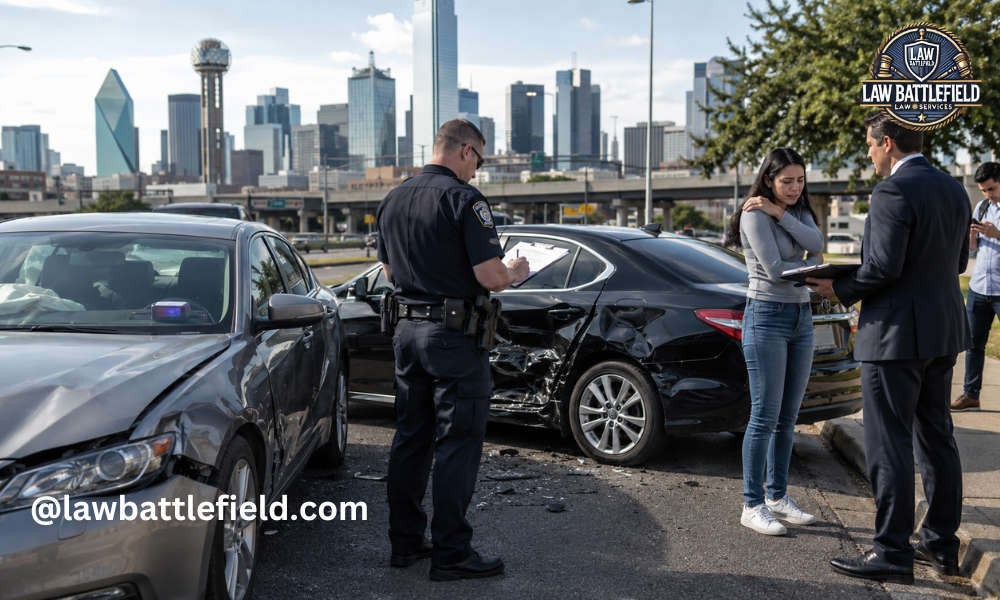
A Dallas Lyft accident lawsuit may help an injured person seek compensation when a rideshare crash causes medical expenses, missed work, property damage, or lasting pain. However, these cases can be more complicated than ordinary car accident claims because several drivers, insurers, and coverage periods may be involved.
A claim may be available to a Lyft passenger, another driver, a pedestrian, a cyclist, or even a Lyft driver injured by someone else. The outcome usually depends on who caused the collision, whether the Lyft app was active, whether the driver had accepted a ride, which insurance policy applied, and how serious the injuries were.
Most cases begin as insurance claims rather than lawsuits. A lawsuit may become necessary when an insurer denies responsibility, disputes the injuries, questions the driver’s app status, or offers less compensation than the injured person believes the claim is worth. Every case is different, so the available evidence matters greatly.
Quick Guide: Dallas Lyft Accident Lawsuit
| Key issue | What readers should know |
| Who may file | Lyft passengers, other motorists, pedestrians, cyclists, and Lyft drivers injured by another person may have a claim. |
| Who may pay | The Lyft driver’s insurer, Lyft’s commercial insurer, another driver’s insurer, or another responsible party may provide compensation. |
| App offline | The Lyft driver’s personal auto insurance normally applies. |
| Driver waiting for a request | Lyft may provide contingent liability coverage when the driver’s personal policy does not cover the accident. |
| Ride accepted or passenger onboard | Lyft’s commercial liability coverage may apply during the active ride period. |
| Available compensation | Medical bills, lost wages, future care, property damage, pain and suffering, and other accident-related losses may be claimed. |
| Texas fault rule | Compensation may be reduced by the injured person’s percentage of fault. Recovery is generally barred at 51% responsibility or more. |
| Filing deadline | Texas generally allows two years to file a personal injury lawsuit, although exceptions and special deadlines may apply. |
| Important evidence | Police reports, photographs, medical records, witness details, ride receipts, app screenshots, and trip data can support the claim. |
| Settlement warning | An early settlement may not cover future medical care, long-term income loss, or lasting physical limitations. |
Steps to Protect a Dallas Lyft Accident Claim
- Call 911 and request police and medical assistance.
- Screenshot the Lyft trip details, including the driver profile, route, receipt, pickup time, and drop-off information.
- Photograph the accident scene, vehicle damage, injuries, traffic signals, road conditions, and surrounding area.
- Collect contact and insurance details from every driver and witness involved.
- Seek prompt medical treatment, even when pain or other symptoms do not appear immediately.
- Preserve records and receipts, including medical bills, wage information, repair estimates, and accident-related communications.
- Avoid accepting an early offer until the full extent of the injuries and future losses is understood.
How a Dallas Lyft Accident Lawsuit Works
An insurance claim is a request for payment under an auto insurance policy. The injured person sends evidence of the crash, medical treatment, lost income, and other losses to the appropriate insurer. The insurer then investigates and may accept, deny, or negotiate the claim.
A personal injury lawsuit is a formal court case. It may be filed when the parties cannot agree about fault, insurance coverage, or compensation.
The process normally begins with an investigation. Police reports, photographs, video recordings, witness statements, medical records, and Lyft trip data may be collected. The responsible parties and their insurance policies are then identified.
After a claim is submitted, settlement discussions may begin. If the dispute is not resolved, the injured person may file a lawsuit. The case can then move through discovery, depositions, expert reviews, mediation, and possibly trial.
Rideshare cases are often harder than regular crashes because the Lyft driver’s personal insurer and Lyft’s commercial insurer may disagree over which policy applies.
Who May Be Held Responsible for a Lyft Accident in Dallas
The responsible party depends on how the accident happened. The Lyft driver may be liable for speeding, distracted driving, unsafe lane changes, or another careless action. Another motorist may be responsible if that person caused the collision.
In multi-vehicle crashes, two or more drivers may share responsibility. Other possible defendants can include a vehicle owner who allowed an unsafe driver to use the car, an employer whose worker caused the accident while performing job duties, or a manufacturer that sold a defective vehicle or auto part.
A government entity may sometimes be involved when a dangerous road condition, broken traffic signal, or poorly maintained public area contributed to the crash. These claims can have special notice rules and shorter deadlines.
Lyft itself may be named only in limited situations involving the company’s own conduct. Responsibility may also be divided among several parties based on each party’s role in causing the collision.
When Lyft May Be Directly Liable
Lyft generally treats its drivers as independent contractors rather than employees. Because of that classification, Lyft is not automatically responsible for every negligent act committed by a driver.
Texas law gives transportation network companies certain protections when they have met their legal duties concerning the driver. However, a direct claim against Lyft may still be considered when evidence suggests that the company failed to follow required safety or screening rules.
Possible issues may include inadequate driver screening, failure to perform required background checks, allowing an ineligible person to remain active on the platform, or failing to meet applicable safety obligations.
A direct claim may also involve the company’s own policies or actions rather than only the driver’s conduct. These cases are highly fact-specific and require evidence showing what Lyft knew, what it was required to do, and whether any failure contributed to the accident.
Lyft Insurance Coverage During Each App Period
The driver’s app status at the exact time of the collision is one of the most important parts of a Dallas Lyft accident lawsuit. Different insurance coverage may apply during different stages.
| Driver status | Likely policy | General coverage | Who may be protected |
| Lyft app offline | Driver’s personal auto policy | Personal policy limits | Injured drivers, passengers, pedestrians, or cyclists |
| App on and waiting for a request | Personal policy or Lyft’s contingent coverage | At least $50,000 per injured person, $100,000 per accident, and $25,000 for property damage | People injured by the Lyft driver |
| Ride accepted and driver traveling to pickup | Lyft commercial coverage | Generally at least $1 million in third-party liability coverage | Passengers, other motorists, pedestrians, and cyclists |
| Passenger inside the vehicle | Lyft commercial coverage | Generally at least $1 million in third-party liability coverage | The passenger and other injured parties |
When the app is offline, Lyft generally provides no rideshare liability coverage. The driver’s personal policy is normally the main source of recovery.
When the driver is logged in but has not accepted a request, Lyft’s contingent coverage may apply if the personal policy does not cover the loss.
Once the driver accepts a ride and is traveling to the passenger, or while the passenger is in the vehicle, higher commercial coverage generally applies. Depending on the policy and the facts, uninsured or underinsured motorist coverage may also be relevant when another driver has little or no insurance.
Coverage is not automatic simply because a Lyft vehicle was involved. The policy terms, driver status, type of loss, and available evidence must still be reviewed.
The Importance of Proving the Lyft Driver’s App Status
App status can determine whether the claim is handled under a personal policy, limited contingent coverage, or the larger commercial policy.
Useful evidence may include the Lyft ride receipt, driver profile, route map, trip timestamps, pickup and drop-off information, and screenshots from the passenger’s phone. Mobile phone data, driver communications, witness statements, and Lyft’s internal electronic records may also become important.
Passengers should preserve their trip information as soon as possible. Other injured parties may need to request digital records during the investigation or lawsuit.
Common Causes of Lyft Accidents in Dallas
Lyft crashes can happen for many of the same reasons as other traffic accidents. However, rideshare driving creates additional distractions.
A driver may look at the app for a new request, directions, passenger information, or pickup instructions. Other causes include speeding, following too closely, fatigue, unsafe lane changes, running traffic signals, driving under the influence, and poor vehicle maintenance.
Accidents may also happen during unsafe pickups or drop-offs when the driver stops in traffic, blocks a lane, or allows a passenger to exit in a dangerous location. Drivers unfamiliar with Dallas highways, exits, construction areas, or busy entertainment districts may make sudden or unsafe moves.
Injuries Commonly Included in Lyft Accident Claims
A rideshare collision can cause whiplash, muscle strains, neck and back injuries, concussions, broken bones, internal injuries, spinal cord damage, or traumatic brain injuries.
Some people experience cuts, scars, disfigurement, emotional distress, sleep problems, or fear of traveling. Severe crashes may lead to permanent impairment and long-term medical care.
Not every injury is obvious at the scene. Headaches, stiffness, dizziness, or back pain may appear hours or days later. Prompt medical evaluation helps protect the person’s health and creates a record connecting the symptoms to the accident.
Compensation Available in a Dallas Lyft Accident Lawsuit
Compensation may cover both financial and personal losses. Economic damages can include ambulance charges, emergency treatment, hospital bills, medication, physical therapy, rehabilitation, future medical care, lost wages, reduced earning ability, and property damage.
Non-economic damages may include physical pain, mental anguish, disfigurement, and loss of normal physical abilities. A spouse may have a loss-of-consortium claim in some situations.
When a Lyft collision causes death, eligible family members may pursue wrongful death damages, which can include lost financial support, loss of companionship, and related losses.
Exemplary damages may be considered in limited cases involving fraud, malice, or gross negligence. They are not available in every accident case.
How the Value of a Dallas Lyft Accident Claim Is Determined
There is no universal average settlement for a Lyft accident. Two people involved in similar collisions may receive very different outcomes.
Claim value depends on the seriousness and permanence of the injuries, medical expenses, need for future care, time missed from work, reduced future income, and the effect of the injuries on daily life.
The strength of the evidence also matters. A clear police report, reliable witnesses, strong medical documentation, and proof of active app status can improve the claim.
Available insurance coverage may limit the practical amount that can be collected. The injured person’s percentage of fault may also reduce compensation. Serious claims are often evaluated after doctors better understand the person’s long-term condition or determine that the patient has reached maximum medical improvement.
Texas Comparative Negligence Rules
Texas follows a modified comparative responsibility system. An injured person can recover compensation if that person is not more than 50% responsible for the accident.
The award is reduced according to the person’s share of fault. For example, if the damages equal $100,000 and the injured person is found 20% responsible, the recovery may be reduced to $80,000.
A claimant found 51% or more responsible generally cannot recover damages.
Insurers may try to shift blame by claiming that another driver was speeding, following too closely, using a phone, failing to brake, or violating a traffic rule. Photographs, video, witness accounts, and crash reconstruction evidence may help answer those arguments.
Deadline for Filing a Lyft Accident Lawsuit in Texas
Texas generally gives an injured person two years from the date the claim arises to file a personal injury lawsuit. In many crash cases, that period begins on the accident date.
Different rules may apply to minors, wrongful death claims, delayed discovery situations, and cases involving government entities. Claims against a city or another public body may also require formal notice well before the ordinary deadline.
Insurance negotiations do not automatically pause or extend the filing period. A person can lose the right to recover even when discussions with an insurer are still continuing.
Evidence That Can Strengthen a Dallas Lyft Accident Claim
Important evidence may include the Dallas police accident report, photographs, vehicle damage, medical records, bills, witness information, traffic-camera recordings, business-surveillance video, and dashcam footage.
Lyft screenshots, ride receipts, driver communications, route information, and electronic data can help prove the commercial nature of the trip. Wage records may establish missed income, while a personal journal can document pain, sleep problems, medical appointments, and the effect of injuries on daily activities.
In disputed cases, medical experts or accident reconstruction professionals may explain how the crash occurred and how it caused the injuries.
Steps to Take Immediately After a Lyft Accident
Call 911, request medical help when needed, and report the collision. Obtain the names, insurance details, vehicle information, and contact information of everyone involved.
Take photographs of the vehicles, injuries, road conditions, traffic signals, and surrounding area. Screenshot the Lyft trip, driver profile, route, and receipt before the information becomes harder to access.
Ask witnesses for their names and phone numbers. Save the police report number and seek medical attention promptly, even when symptoms initially seem minor.
Avoid arguing about fault at the scene. Preserve damaged property, clothing, receipts, electronic messages, and other evidence connected to the accident.
Mistakes That Can Weaken a Lyft Accident Lawsuit
Delaying medical care can allow an insurer to argue that the injuries were minor or unrelated. Missing appointments or ignoring medical advice may create similar problems.
Giving a recorded statement without preparation, signing broad medical authorizations, or accepting an early settlement can also weaken a claim. An early offer may not account for future treatment, long-term pain, or lost earning ability.
Social media posts can be misunderstood or used out of context. Losing Lyft screenshots, deleting messages, or missing the filing deadline may make recovery more difficult.
Dealing With Lyft and Insurance Adjusters
Lyft-related claims may involve the driver’s personal carrier, Lyft’s insurance administrator, another driver’s insurer, or several companies at once.
Adjusters may ask for recorded statements, medical files, wage records, or signed authorizations. These requests should be reviewed carefully because some may seek information far beyond what is necessary.
Insurers may also disagree over whether the app was active or whether the ride had already started. Before accepting a settlement, the injured person should understand the full value of the losses and the effect of signing a release. A signed release usually ends the claim permanently.
Filing a Claim as a Lyft Passenger
Passengers are rarely responsible for causing a rideshare collision. A passenger may have a claim against the Lyft driver, another negligent motorist, or both.
Confirming that the ride was active is especially important because it can establish access to Lyft’s commercial coverage. The passenger should preserve the receipt, trip history, driver details, and medical records.
If an uninsured, underinsured, or hit-and-run driver caused the collision, additional coverage may be available depending on the policy and circumstances.
Filing a Claim as Another Driver, Pedestrian, or Cyclist
Another motorist, pedestrian, or cyclist must usually prove that the Lyft driver acted negligently and caused the injuries.
App status remains important because it helps identify the correct insurer. The claimant should also document medical treatment, missed income, property damage, and any lasting physical limitations.
The insurer may argue that the claimant shared fault. Traffic video, witnesses, vehicle damage, and electronic data can help establish what happened. Hit-and-run and uninsured-driver cases may require a separate review of available first-party coverage.
Dallas Police Reports and Local Accident Documentation
Calling the Dallas Police Department creates an official record of the crash. A report may include driver information, insurance details, witness names, road conditions, diagrams, citations, and the responding officer’s observations.
A police report can support a claim, but it does not automatically decide who is legally responsible. Insurers and courts may consider other evidence as well.
Keep the report number, officer’s name, witness details, photographs, and all documents received at the scene.
What Happens After a Lyft Accident Lawsuit Is Filed
A lawsuit usually begins with a petition filed in court. The defendants are served and given time to respond.
The parties then exchange written questions, documents, medical records, insurance information, and electronic evidence. Depositions may be taken under oath. The defense may also request an independent medical examination.
Experts may review medical issues, future losses, vehicle damage, or crash mechanics. Settlement talks can continue throughout the case, and mediation may be used to seek an agreement.
If the dispute remains unresolved, the case may proceed to trial. A judge or jury then decides responsibility and damages. Many claims settle before trial, but no particular outcome can be guaranteed.
Settlement Versus Trial in a Lyft Accident Case
Settlement can provide a faster and more predictable result. It also avoids the uncertainty and stress of trial. However, accepting a settlement normally means giving up the right to seek more money later.
A trial may become necessary when the parties disagree about fault, app status, insurance coverage, injury severity, or the value of the claim. Trials can take longer and involve additional costs, preparation, and uncertainty.
Before settling, the injured person should consider future treatment, unpaid bills, lost income, long-term limitations, legal expenses, and the strength of the evidence.
Conclusion
A Dallas Lyft accident lawsuit can involve several layers of responsibility and insurance coverage. The driver’s app status, cause of the crash, severity of the injuries, available policies, and strength of the evidence can all shape the result.
Prompt medical care, a police report, photographs, witness details, and preserved Lyft trip records may help protect a claim. Texas’s filing deadline and comparative-fault rules must also be considered.
Because every accident has different facts, injured people should carefully review the evidence and available insurance before making decisions about settlement or litigation.
Dallas Lyft Accident Lawsuit Questions Readers Commonly Ask
Can I Sue Lyft After Being Injured As A Passenger?
You may pursue compensation after a Lyft crash, but the proper defendant may be the driver, another motorist, Lyft’s insurer, or Lyft itself in limited circumstances.
Which Policy Applies When The Driver Is Waiting For A Request?
The driver’s personal policy may apply first. If it does not, Lyft lists contingent liability coverage of at least $50,000 per person, $100,000 per accident, and $25,000 for property damage.
What If Another Driver Caused The Crash?
The claim may be filed against that driver’s insurer. Other coverage, including uninsured or underinsured motorist protection, may also be relevant.
Can I Recover Compensation If I Was Partly At Fault?
Possibly. Texas allows recovery when your responsibility is 50% or less, but your compensation is reduced by your percentage of fault.
How Long Do I Have To File?
The general Texas deadline is two years, although exceptions and special rules may apply.
Does Lyft Insurance Cover Hit-and-run Accidents?
Coverage may be available, but it depends on the active ride period, policy terms, and applicable uninsured motorist coverage.
What If The Driver’s Personal Insurer Denies The Claim?
Lyft’s contingent or commercial policy may apply depending on the driver’s app status.
How Long Can The Case Take?
Some claims settle within months, while disputed or serious injury cases may take much longer.
Should I Accept The First Offer?
Not before understanding whether it covers future medical care, income loss, pain, and other long-term effects.
What Proves That A Ride Was Active?
Useful proof includes the receipt, trip history, route, timestamps, driver information, screenshots, phone records, and Lyft’s electronic data.
Was this article helpful? Check out more on Lawbattlefield.com
Disclaimer: This article is provided for general informational and educational purposes only. It does not constitute legal advice and does not create an attorney-client relationship. Rideshare insurance policies, Texas laws, filing deadlines, and individual case outcomes may vary based on the facts. Anyone affected by a Lyft accident should consider speaking with a qualified Texas attorney for advice about their specific situation.
Top Causes Of Car Accidents In Wauwatosa & How To Avoid Them