Sharing the roadways with large commercial trucks is just part of driving. America still relies very heavily on long-haul, freight, and delivery trucks to drive commerce throughout the nation. However, many regular drivers underestimate the needs and range of these large trucks. This ends up leading to smaller cars and SUVs crowding semi-trucks on the highway, which can cause serious accidents.
One of the most important things to realize on the road is just how much space commercial trucks actually require. Sure, there are some by-the-numbers questions that you must pass on your driver’s test. Though for most drivers, it’s been decades since they’ve taken those tests, and many trucks have only gotten bigger in the meantime. Large trucks need a lot of space for a variety of reasons. Whether it’s a sudden crash, a safety hazard, bad weather, or an incompetent truck driver, it’s vital to give these trucks room on the road.
Understanding why these commercial trucks need a lot of physical space may help you avoid accidents while driving. However, if you get involved in an accident, or if you or a loved one have already been involved in one, it’s important to seek out a qualified truck accident lawyer like the attorneys at Prince Law Firm to help you navigate the field.
The Physics of Stopping Distance and Momentum
The main reason that large commercial trucks need a lot of space is due to basic physics. Weight plus momentum makes trucks a constant rolling hazard. Even with a competent driver, trucks still have large blind spots and take up a whole lot of space when turning or changing lanes. A fully loaded semi-truck can weigh up to 40 tons, which is roughly 20 times heavier than the standard passenger vehicle. Imagine a basketball smashing into a chicken egg at high speeds.
Immense forward momentum is much harder to change or stop due to the sheer mass involved. It takes an incredible amount of energy to dissipate this momentum. This is why trucks employ air brakes that are closer to what trains use than basic cars. Under ideal conditions, it takes around 500 to 525 feet for a semi-truck to stop if it’s traveling 65 MPH (highway speeds)—almost as long as two football fields. Trucks rear-end thousands of passenger vehicles every year, in large part due to drivers not traveling far enough ahead of these commercial trucks.
One of the biggest potential hazards arises due to the discrepancy in stopping times. Drivers who travel a normal distance in front of a semi-truck may need to slow down quickly due to an upcoming accident or a hazard. While a normal vehicle can stop in seconds, a commercial truck simply cannot. Following too closely to a large truck is dangerous enough; not driving far enough ahead can easily spell disaster.
Mechanical Factors and Reaction Time Lag
There are a few mechanical factors that inhibit a truck’s ability to stop and maneuver quickly. It all really comes down to a lack of quick action. Focusing on the braking difference, normal automobiles have hydraulic braking, which is effectively instantaneous. Heavy-duty air braking systems act much differently.
With air brakes, you almost always get what is known as “brake lag.” This heavily influences a truck’s ability to respond to emergency situations. In short, there’s no possible way for a large truck to stop suddenly; it has to lose its momentum. The lag may be less than a second, but this equates to time and distance that matter greatly in an emergency.
It is highly recommended that you stay in an opposite lane if at all possible. If this isn’t feasible on the roadway, then staying a few hundred feet ahead of a truck is always a smart move.
Managing Blind Spots and Wide Turns
It’s not just rear-ending accidents that are an issue with trucks on the road, nor is that the only reason they need space. There are two other main reasons that you should always give commercial trucks a wide berth and avoid driving near them if you can.
Massive Blind Spots
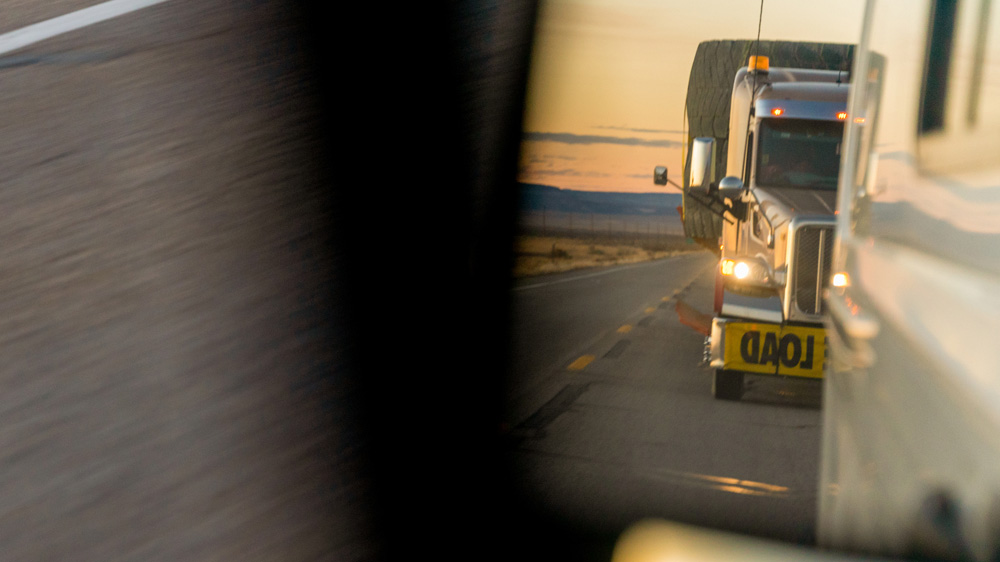
Large trucks have exponentially larger blind spots than smaller automobiles on either side of the vehicle. They also exist immediately in front of the cab. If anything is in front of or beside a large commercial truck, the driver will likely never even know it because they simply cannot see these areas of the road. It is very important never to ride directly beside a commercial truck. Speed up ahead, or slow down and let them pass you. Driving directly alongside a big truck could end up very badly.
The Need for Wide Turns
Due to the physical length of a commercial vehicle, these trucks often need to swing wide. They sometimes have to move over into adjacent lanes just to complete a standard turn without running over curbs or striking any objects. These are known as “pinch points,” and many drivers get caught inside of them every year. Again, the best course of action is always to steer clear of these trucks while on the road.
How to Proceed if Injured in a Truck Accident
According to recent statistics, there are around 500,000 commercial truck accidents every year, which claim about 6,000 lives and cause many thousands of injuries. If you or a loved one has been injured in an accident, your first step immediately after caring for your health should be to obtain a good truck accident lawyer. A qualified attorney can help you fight against insurance companies while compiling evidence, medical records, and more to ensure you get just compensation.
If at all possible, it’s important to avoid semi-trucks and other large commercial vehicles while you’re on the road. If it puts your destination off for a few minutes, it’s well worth the wait not to risk a serious accident. If you have already experienced an accident, please find a reputable lawyer to help you in the situation.