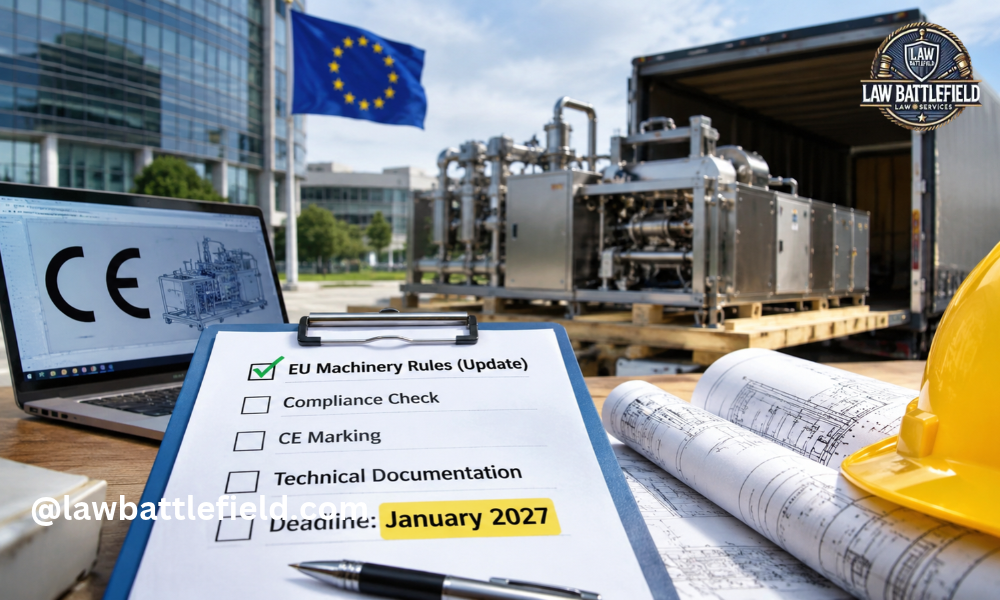
If your company sells machinery into the European Union, a legal change is coming that most US exporters have not prepared for. On January 20, 2027, the EU’s old Machinery Directive disappears and a new Machinery Regulation takes its place. There is no overlap period, no grace window, and no softer version for companies based outside Europe.
For a business that spent years getting comfortable with the old rules, this is a reset. The legal basis for selling a machine in Europe changes overnight, and a product that was compliant on January 19 may not be compliant on January 20 if it is placed on the market under the new rules.
Why This Change Hits Harder Than Past Updates
The first thing to understand is the legal form of the change. The old rules came as a Directive, which each EU country turned into its own national law. The replacement is a Regulation, which applies directly and identically across all 27 member states the moment it takes effect.
For an exporter, that removes a familiar cushion. There is no national transposition to wait for, no country-by-country timeline to track. The obligations land everywhere at once on the same date.
And that date is fixed. Industry groups asked for a delay, and the answer was no. The Regulation applies from January 20, 2027, and the Machinery Directive stops applying the same day, with no coexistence period.
What Actually Changes for Your Product
The headline change is cybersecurity. For the first time, a machine’s digital security becomes a legal safety requirement. Connecting a device to your machine, locally or remotely, must not create a hazardous situation. Safety-related software has to be protected against corruption, and control systems must withstand foreseeable malicious interference.
The scope of these new requirements, and how they interact with existing safety obligations, is set out in detail in the new Machinery Safety Regulation. For a US manufacturer whose machines were never designed with connectivity risk in mind, this is the hardest part to retrofit.
There is more. Machines with self-evolving or autonomous behavior now carry specific obligations to stay within their defined task space and remain correctable. Safety components that use machine learning for a safety function require third-party assessment by a Notified Body. And the rules on substantial modification are now explicit, which matters because a company that modifies a machine after it is on the market can legally become its manufacturer, with all the obligations that follow.
The Documentation Burden Is Real
The new rules also change how you document and deliver a machine. Instructions can be digital, but they have to stay available online for the machine’s expected lifetime and for at least ten years after it goes on the market. A buyer can still request a free paper copy at purchase, and you have one month to deliver it.
For conformity assessment, the category of your machine decides the path. Six categories always require a Notified Body. Another nineteen can use internal production control, but only if the machine follows the relevant harmonized standards. Knowing which bucket your product falls into is the difference between a self-assessment and a mandatory third-party review, and that affects both cost and timeline.
Why This Is a Legal Exposure Question, Not Just a Technical One
For a company’s legal and compliance team, the real issue is liability. Placing a non-compliant machine on the EU market after January 20, 2027 is not a paperwork slip. It exposes the manufacturer to market surveillance action under the EU’s enforcement regulation, product recalls, and the broader liability that comes with an unsafe product in the European market.
The obligation falls on whoever places the product on the market, and for a non-EU manufacturer that responsibility does not disappear by selling through a distributor. Importers and distributors now carry their own duties, but the manufacturer remains the party that has to get the machine right in the first place.
This is where many exporters underestimate the work. Mapping a machine against the new Regulation, identifying its conformity path, and closing the gaps takes months, not weeks. Companies that want certainty before the deadline often bring in specialist CE marking support rather than discover a compliance gap when a shipment is already sitting at a European port.
What To Do Before January 2027
Start by confirming whether your machine falls under the new Regulation and which conformity assessment path applies to it. From there, the priorities are the cybersecurity requirements, the documentation obligations, and any substantial modifications that might have quietly changed who counts as the manufacturer.
The companies that will struggle are the ones treating January 2027 as a distant date. The Regulation is already law, the requirements are already published, and the standards that support them are arriving now. Waiting for enforcement to clarify the rules means waiting until it is too late to act on them.
A machine stopped at the European border is a lost sale and a legal problem at the same time. The exporters who treat this change as a deadline they are already working toward are the ones who will keep selling in Europe without interruption.
Was this article helpful? Check out more on Lawbattlefield.com